Employers must implement a formal program when worker noise exposure reaches or exceeds 85 decibels over an eight hour time weighted average. Essential OSHA hearing conservation program requirements include conducting noise monitoring, providing annual audiometric testing at no cost, and delivering comprehensive employee training on hearing protection usage.
Navigating OSHA 1910.95 often feels like an administrative burden for small business owners and healthcare administrators who already manage complex operational risks. Some view noise compliance as a mere checkbox, but failing to implement a rigorous hearing conservation program can lead to irreversible employee injuries and significant regulatory penalties. At SEAI Global, we recognize that professional compliance requires a strategic blend of technical accuracy and practical execution. This guide provides a definitive roadmap for 2026, covering essential exposure assessments and the nuances of audiometric testing for smaller teams. You will learn how to select PPE beyond the myths of Noise Reduction Ratings; we will also outline the annual training requirements and recordkeeping standards needed to align with OSHA and the Joint Commission. We provide the clarity you need to move beyond simple compliance and build a sustainable culture of auditory safety.
Understanding the OSHA Noise Standard 1910.95 Requirements for Employers
The OSHA Noise Standard, codified as 29 CFR 1910.95, establishes the regulatory framework for protecting workers from permanent hearing loss caused by high-decibel environments. For small businesses heading into 2026, strict adherence to these regulations is a financial necessity. OSHA continues to adjust penalty structures for inflation, meaning that a single oversight in your safety protocol can result in five-figure fines. For Melbourne-based manufacturing and healthcare facilities, noise is often an overlooked hazard; it does not leave a visible trail like a chemical spill or a trip hazard, yet its impact on workers is irreversible.
Employers must distinguish between two critical thresholds: the Action Level and the Permissible Exposure Limit (PEL). When noise exposure reaches the Action Level of 85 decibels (dBA) as an 8-hour time-weighted average, the employer is legally required to implement a formal hearing conservation program. This includes monitoring, audiometric testing, and training. The PEL is 90 dBA; this is the maximum level of noise a worker can be exposed to over an 8-hour shift without mandatory administrative or engineering controls.
OSHA utilizes the 'Rule of 5,' also known as a 5-dB exchange rate. This means that for every 5-decibel increase in volume, the allowable exposure time is cut in half:
Noise Level (dBA) | Permissible Exposure Duration (Hours) |
|---|---|
90 | 8.0 |
95 | 4.0 |
100 | 2.0 |
105 | 1.0 |
110 | 0.5 |
115 | 0.25 |
Small firms often assume their facilities are below these thresholds without conducting formal workplace safety inspections. In reality, common equipment in medical labs or aerospace machine shops can easily exceed these limits. Implementing comprehensive risk management solutions ensures that your business identifies these hazards before they lead to an inspection or a workers' compensation claim.
Step 1: Noise Monitoring and Exposure Assessment
Quantifying employee exposure is the first operational step in meeting OSHA hearing conservation program requirements. An initial noise survey identifies which workers fall at or above the 85 dBA Action Level. This assessment typically utilizes two distinct methods: area monitoring and personal monitoring. Area monitoring employs a sound level meter to map noise levels produced by specific machinery or in designated zones. This is useful for identifying where warning signs must be posted; however, it often fails to capture the true exposure of a mobile worker.
Personal monitoring utilizes a noise dosimeter worn by the employee for a full shift. In Melbourne’s aerospace and medical manufacturing sectors, equipment-driven noise fluctuations are common. A CNC machining center in an aerospace shop may produce steady noise, while nearby pneumatic testing creates intermittent spikes. Similarly, high-speed packaging lines in medical device facilities often have variable noise profiles based on production speed. Dosimeters are essential in these environments because they integrate all sound levels over the work shift to calculate a precise Time-Weighted Average (TWA).
Employers must re-monitor whenever a change in production, process, equipment, or controls increases noise levels to the point where additional employees may be exposed at the Action Level. Professional workplace safety inspections or comprehensive risk management solutions should be scheduled following any shop floor reconfiguration to ensure that previous data remains valid and compliant.
Step 2: Implementing Audiometric Testing for Small Teams
Once noise monitoring confirms that employees are exposed to levels at or above the 85 dBA Action Level, the firm must establish a medical surveillance program. A primary hurdle for small firms is identifying what is required for audiometric testing when they lack on-site medical staff. Most businesses in Melbourne fulfill this by partnering with mobile testing units or local occupational health clinics to ensure consistent data collection.
The process begins with a Baseline Audiogram, which serves as the reference point against which all future tests are compared. This must be conducted within six months of an employee's first exposure at the Action Level. Following the baseline, employers must provide an Annual Audiogram. The goal of this recurring test is to identify a Standard Threshold Shift (STS), defined by OSHA as a change in hearing threshold relative to the baseline of an average of 10 dB or more at 2000, 3000, and 4000 Hz in either ear.
If an STS is detected, the employer has a strict legal obligation to notify the affected employee in writing within 21 days of the determination. This notification should include a plan for follow-up, such as re-fitting hearing protection or professional medical referrals. To maintain compliance, these testing dates should be integrated into your comprehensive risk management solutions. Coordinating these evaluations alongside annual OSHA training services ensures that medical records remain up to date and that employees understand the health implications of their specific work environment. Properly managed audiometric data is a cornerstone of effective OSHA hearing conservation program requirements, providing the only objective proof that your PPE and engineering controls are actually working.
Step 3: Hearing Protection PPE Standards and the NRR Myth
If audiometric testing reveals a Standard Threshold Shift or if noise monitoring confirms levels reaching the 90 dBA PEL, the employer must ensure employees wear appropriate hearing protection. A common industry query involves the "OSHA decibel limit for hearing protection." While 90 dBA is the legal limit for an unprotected eight-hour shift, OSHA requires that hearing protection attenuate the noise to at least an eight-hour TWA of 90 dBA; for employees who have already experienced an STS, that protection must bring exposure down to 85 dBA or below.
The efficacy of earplugs or muffs is measured by the Noise Reduction Rating (NRR), yet the number on the packaging is rarely achieved in the field. Laboratory conditions do not account for poor fit, facial hair, or safety glasses breaking the seal of an ear muff. To account for these variables, OSHA applies a specific de-rating formula: (NRR - 7) / 2. The subtraction of 7 is necessary to adjust for the technical difference between the C-weighted noise used in lab tests and the A-weighted noise (dBA) typically measured during workplace safety inspections. Dividing the remainder by two provides a necessary safety margin for real-world application errors.
Consider a technician in a Melbourne aerospace facility working near a 95 dBA specialized milling machine while wearing earplugs with an NRR of 29. To calculate the actual protection, subtract 7 from 29 to get 22, then divide by 2, resulting in 11 decibels of effective reduction. The worker’s estimated exposure is 84 dBA (95 minus 11). Because this falls below the 85 dBA Action Level, the PPE is sufficient. If the calculation reveals an exposure above these limits, the firm must provide higher-rated PPE or implement comprehensive risk management solutions such as sound-dampening enclosures.
Step 4: OSHA Hearing Conservation Program Training Requirements Annual
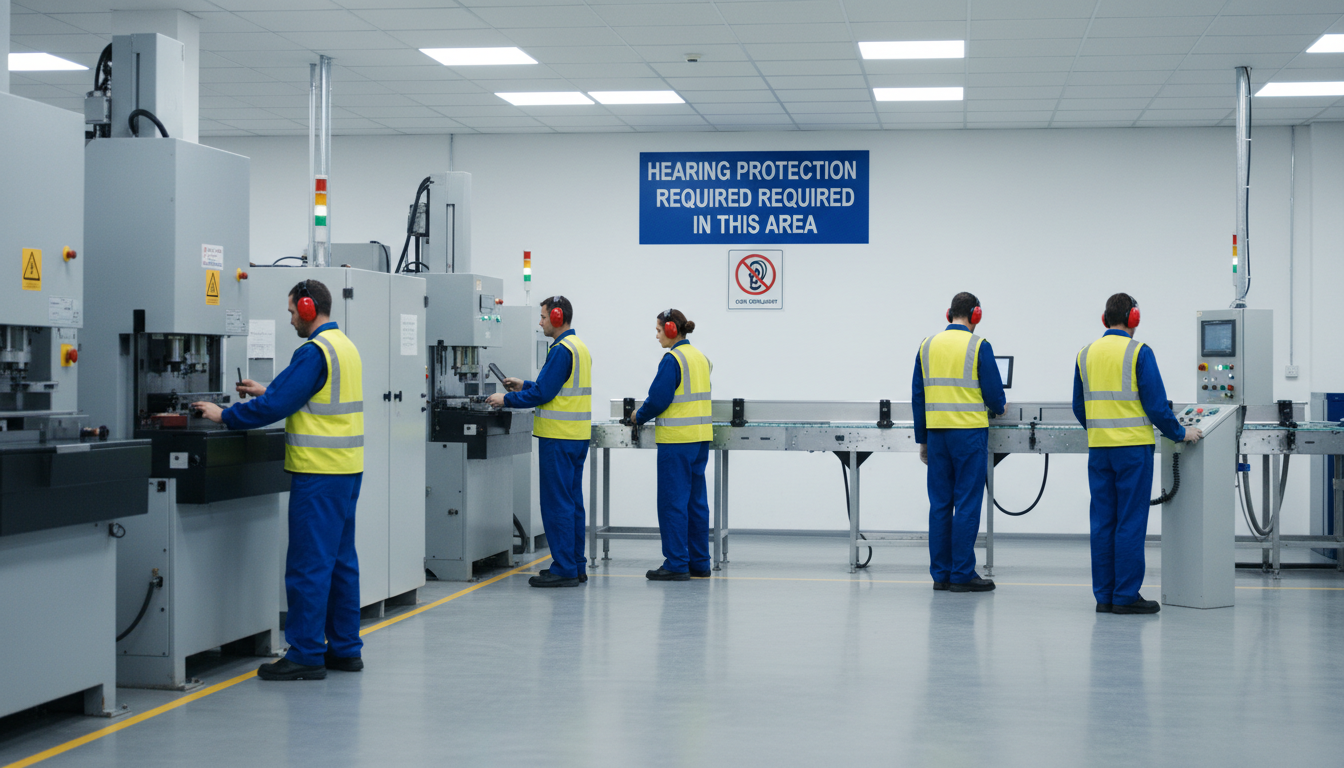
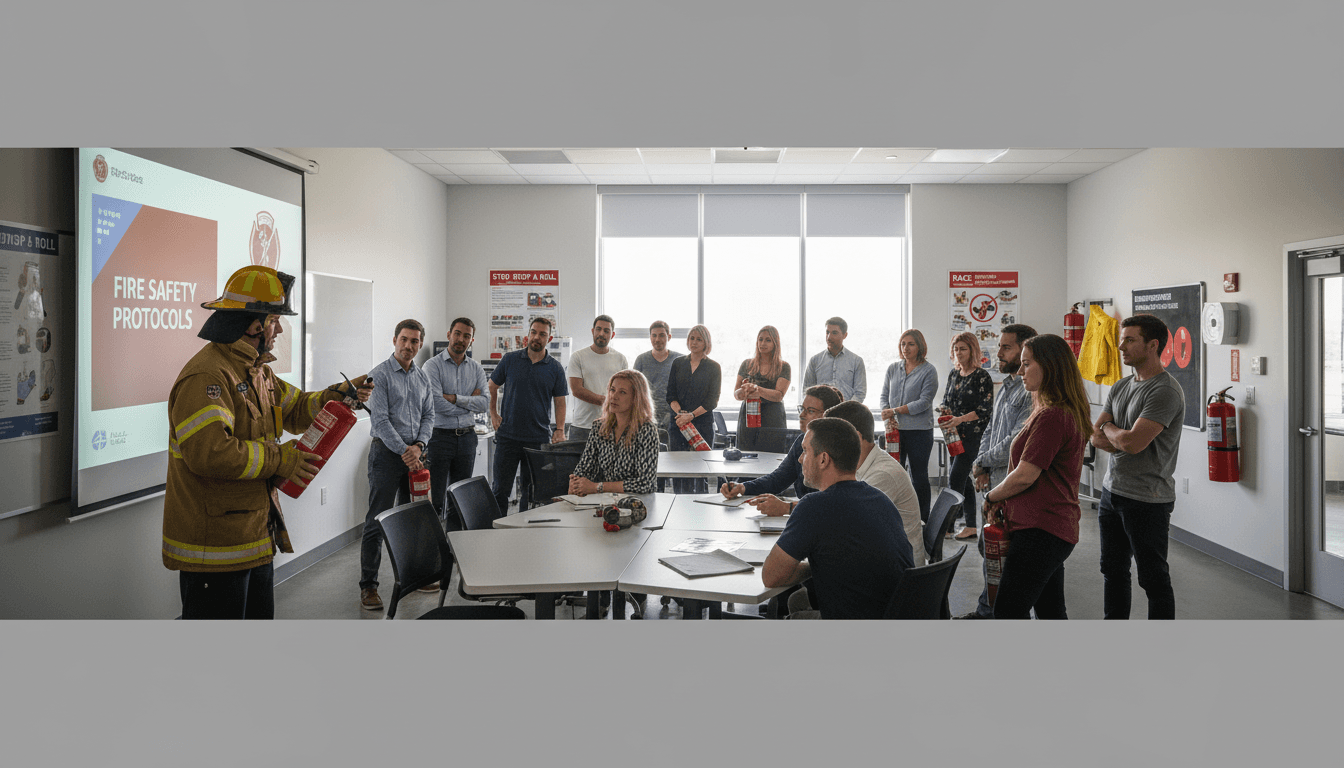
Training is the operational bridge that transforms a written policy into a functional safety culture. Under OSHA hearing conservation program requirements, employers must provide annual training for every employee exposed to noise at or above the 85 dBA Action Level. This is not a one-time onboarding task; it is a recurring legal obligation designed to reinforce proper habits and address evolving risks on the shop floor.
To remain compliant, the training session must explicitly cover these regulatory topics:
The physiological effects of noise on human hearing.
The purpose of hearing protectors, including the advantages and disadvantages of different PPE types and their specific attenuation ratings.
Detailed instructions on the selection, fitting, use, and daily care of earplugs or muffs.
The purpose and procedure of audiometric testing and how it tracks hearing health over time.
For small businesses in Melbourne, logistical efficiency is paramount. A best practice is to coordinate these OSHA training services with your scheduled annual audiograms. This combined approach minimizes production downtime and ensures that the technical explanations of hearing loss are immediately reinforced by the testing process. Integrating these sessions into your comprehensive risk management solutions ensures no employee is overlooked, preventing the documentation gaps often identified during workplace safety inspections.
Step 5: Recordkeeping and the Two-Year Rule
Compliance with OSHA hearing conservation program requirements is validated through meticulous documentation. Under 29 CFR 1910.95(m), employers must adhere to two distinct retention schedules. Noise exposure measurements, which include the results of area monitoring and personal dosimetry, must be retained for at least two years. Conversely, audiometric test records have a significantly longer lifespan; these must be kept for the entire duration of the affected worker’s employment.
These records are the first items requested during workplace safety inspections. If an inspector asks for the baseline audiogram of a tenured employee, the inability to produce it immediately can trigger a willful or serious citation. SEAI Global LLC assists Melbourne firms by implementing comprehensive risk management solutions that centralize these files. We ensure that noise survey data and medical surveillance results are organized and easily retrievable. This proactive organization transforms recordkeeping from a clerical burden into a powerful defense against regulatory scrutiny and potential workers’ compensation claims.
Special Considerations for Healthcare: OSHA and Joint Commission Alignment
Noise is often dismissed in clinical environments as a secondary concern, yet specific departments in Florida healthcare facilities consistently approach or exceed regulatory decibel limits. MRI suites can generate acoustic noise levels reaching 100 dBA or higher during certain pulse sequences, necessitating strict protection protocols for both patients and technicians. Central Sterile Processing (CSP) units are equally high-risk zones due to the constant operation of ultrasonic cleaners, high-pressure steam venting, and the mechanical clatter of metal surgical trays. Furthermore, facilities maintenance teams managing industrial chillers, boilers, and emergency generators frequently operate in environments that trigger federal mandates.
For Melbourne healthcare providers, aligning with OSHA hearing conservation program requirements provides a strategic advantage during accreditation cycles. The Joint Commission Environment of Care (EC) standards require organizations to identify and manage risks to staff safety. By conducting workplace safety inspections and implementing comprehensive risk management solutions tailored to OSHA 1910.95, a facility simultaneously satisfies TJC standard EC.02.02.01, which requires the management of hazardous materials and physical risks. Documenting OSHA training services for clinical and support staff serves as objective evidence of a proactive safety culture. This unified approach ensures that noise monitoring data used for legal compliance also functions as the risk reduction evidence required for successful Joint Commission surveys.
Common Mistakes Small Businesses Make with Hearing Conservation
Small businesses often fall into avoidable traps that lead to significant citations. One frequent error is failing to provide a variety of hearing protection. OSHA mandates that employers offer more than one type of PPE, ensuring employees can find a fit that is comfortable and effective for their unique ear canal shape. Simply providing a single brand of foam plugs is insufficient for meeting OSHA hearing conservation program requirements.
Another critical oversight is ignoring impulsive or impact noise. While many focus on the eight-hour average, exposure to noise peaks exceeding 140 dB must be strictly managed, as even a single event can cause permanent damage. Furthermore, many firms fail to update their written safety plans. A stagnant document that does not reflect new machinery or shop floor layouts will fail workplace safety inspections. To mitigate the impact of the 2026 penalty increases, firms should leverage comprehensive risk management solutions and expert OSHA training services to ensure their protocols remain dynamic and legally defensible.
Maintaining an effective hearing conservation program is a vital step in protecting your workforce and ensuring long-term operational success. While the 2026 guidelines provide a clear framework, navigating the technical details of noise monitoring and audiometric testing can be challenging for busy small business owners. If you want expert help streamlining this process, SEAI Global LLC is here to support you. Our team specializes in comprehensive OSHA Compliance solutions tailored to your specific industry needs, allowing you to focus on growth while we handle the safety details.