

An emergency action plan for a Florida workplace is a required safety document for most employers that outlines evacuation procedures and emergency response roles to ensure OSHA compliance. While businesses with more than ten employees must maintain a written plan for staff review, smaller organizations may communicate their procedures orally to meet federal standards. Proper implementation of these protocols ensures disaster readiness and minimizes the risk of injury during workplace emergencies.
Florida business owners face a unique set of challenges that extend far beyond standard operational risks. Between the seasonal threat of devastating hurricanes and the requirements of OSHA 1910.38 compliance, maintaining a safe workplace often feels like an overwhelming task. A generic emergency plan is no longer sufficient in a landscape where regulatory scrutiny is increasing and environmental volatility is the norm. Failing to establish a robust, site-specific Emergency Action Plan (EAP) puts your employees at risk and exposes your organization to significant legal liabilities. This guide provides a comprehensive look at building a compliant EAP tailored specifically to the Florida market. We will explore the critical elements of the OSHA standard, the nuances for healthcare facilities, and how to integrate protocols for both natural disasters and workplace violence. You will gain the practical insights needed to protect your workforce while ensuring total regulatory alignment.
The Critical Role of Emergency Action Plans for Florida Employers
An Emergency Action Plan (EAP) is the primary line of defense between a sudden workplace crisis and a coordinated, safe response. In Florida, the stakes for preparedness are exceptionally high. While federal OSHA standards provide the baseline, the diverse geography from the Space Coast to the Gulf Coast demands a more robust approach than any generic template can provide. Flash flooding, sudden severe weather, and unique industrial hazards require localized planning.
SEAI Global LLC, based in Melbourne, Florida, understands these regional nuances. We work with local employers to move beyond simple documentation toward comprehensive risk management solutions that actually function during a crisis. A well-constructed emergency action plan Florida workplace strategy serves three critical purposes: it protects human life, reduces physical property damage, and ensures rigorous legal compliance.
Relying on a basic online form often leaves gaps that become apparent only when an inspector arrives or an incident occurs. Our team specializes in OSHA compliance audits and OSHA training to ensure your staff knows exactly how to respond when seconds matter. By prioritizing a plan tailored to Florida’s specific environmental and regulatory landscape, businesses can maintain continuity and fulfill their duty of care to their employees.
Understanding the OSHA 1910.38 Standard in Florida
Navigating the regulatory landscape begins with 29 CFR 1910.38, the federal standard that dictates how a business must respond to life threatening situations. At its core, an EAP is a formal document designed to organize and facilitate employer and employee actions during workplace emergencies. It ensures that every individual knows their role when an alarm sounds, reducing the likelihood of injury or chaotic evacuation.
A frequent point of confusion during OSHA compliance audits is whether a business is legally required to maintain this document. While 1910.38 does not apply to every employer by default, it is triggered by several other OSHA standards. The most common trigger is 29 CFR 1910.157, which covers portable fire extinguishers. If your facility provides fire extinguishers for employee use, or if you have a policy requiring certain staff to stay behind to shut down critical systems, a written plan becomes mandatory.
In the practical context of a Florida workplace, this means almost all local businesses require a plan. Even if a specific standard does not strictly mandate it, maintaining an EAP is considered a foundational element of comprehensive risk management solutions. Without a defined plan, employers may find themselves in violation of the General Duty Clause, which requires a workplace free from recognized hazards. Our team often sees that businesses investing in proactive OSHA training are better equipped to navigate these technicalities, ensuring their emergency action plan Florida workplace strategy is both compliant and functionally sound.
The 10 Employee Rule: Written vs. Oral Plans
Determining the format of your plan depends largely on the size of your workforce. Under OSHA 1910.38(b), employers with 10 or fewer employees are permitted to communicate their emergency procedures orally. However, once a business reaches 11 or more employees, the plan must be a formal, written document kept at the workplace and made available for employee review at all times.
While the oral option exists for very small teams, SEAI Global LLC strongly recommends that even small Melbourne startups and boutique firms maintain a written emergency action plan as part of their Florida workplace strategy. Relying on memory during a high-stress event like a tropical storm or a fire often leads to critical failures. A written document provides a standardized reference point for OSHA training and ensures that seasonal or new staff receive the exact same instructions as long-term employees.
For growing companies in Brevard County, transitioning to a written format early is a key component of comprehensive risk management solutions. It simplifies future OSHA compliance audits and provides a clear audit trail of safety protocols. Regardless of your staff size, the plan must be accessible; it cannot be locked in a remote administrative office or hidden in an inaccessible digital folder where employees cannot reach it during an emergency.
The 6 Essential Elements of an OSHA Compliant EAP

Regardless of the format chosen for your emergency action plan Florida workplace documentation, OSHA specifies exactly what must be included to meet the legal standard. 29 CFR 1910.38(c) outlines six minimum elements that serve as the foundation of any safe operation. At SEAI Global LLC, we view these items as the regulatory floor; they ensure basic life safety but often require enhancement to address the complex risks found in Melbourne's industrial and healthcare sectors.
Your plan must specifically address these six areas:
Procedures for reporting a fire or other emergency: This includes the specific method of alerting local emergency services and the internal system for notifying every individual on-site.
Procedures for emergency evacuation, including type of evacuation and exit route assignments: Employers must clearly define primary and secondary exit routes while ensuring they are appropriately marked and unobstructed at all times.
Procedures to be followed by employees who remain to operate critical plant operations before they evacuate: This identifies specific personnel who must perform tasks like shutting down power, gas, or specialized equipment before exiting to prevent a secondary catastrophe.
Procedures to account for all employees after evacuation: This is the accountability phase, requiring a designated assembly point and a reliable method for verifying that every person has safely exited the building.
Procedures to be followed by employees performing rescue or medical duties: If your facility designates staff for first aid or rescue roles, their specific duties and limitations must be clearly documented.
The name or job title of every employee who may be contacted by employees who need more information about the plan: This ensures there is a clear, reachable chain of command for safety inquiries.
Failing to address any of these points can lead to significant deficiencies during OSHA compliance audits. Integrating these elements into regular OSHA training ensures your team is not just compliant on paper, but prepared in practice. While these six steps are mandatory for federal compliance, comprehensive risk management solutions often involve expanding these protocols to include the unique environmental threats that local businesses face daily.
Customizing Your EAP for Florida Hazards: Hurricanes and Tropical Storms

While the six federal elements provide a skeletal framework, a Melbourne-based company must flesh out these requirements to address the reality of hurricane season, which runs from June 1 to November 30. A generic plan often fails to account for the unique logistical challenges of the Space Coast. For instance, your emergency action plan Florida workplace protocol should include a specific go/no-go decision matrix based on local conditions. This matrix must account for sustained wind speeds and the potential closure of local bridges, such as the Eau Gallie or Melbourne Causeways, which can trap staff on either side of the Indian River Lagoon if they are not released in time.
Effective comprehensive risk management solutions go beyond simple evacuation. They detail the exact procedures for securing physical infrastructure, such as installing storm shutters or moving ground floor inventory to elevated positions to mitigate flooding risks. Data redundancy is equally vital; your plan must specify when and how critical digital records are backed up to off-site or cloud servers before a storm makes landfall. These technical details are often missed during standard OSHA compliance audits but are essential for long-term business continuity.
Monitoring is another critical element. Your plan should designate a specific staff member to track Brevard County Emergency Management alerts rather than relying on general national news. Triggers should be clearly defined: at what alert level do you cease operations, and at what point do you initiate final shutdown procedures? Integrating these specifics into your OSHA training ensures that when a tropical system approaches, your team reacts with precision rather than panic.
Addressing Active Shooter Threats and Workplace Violence
While weather events follow a predictable seasonal pattern, workplace violence and active shooter threats can emerge without warning. Integrating a response strategy into your emergency action plan and Florida workplace documentation is no longer optional for prudent employers. These protocols must move beyond the basic six OSHA elements to address specific survival tactics and behavioral indicators.
The industry standard for these events is the Run, Hide, Fight model. The Run phase involves having pre-determined escape routes that are clear of obstructions at all times; a detail our team emphasizes during OSHA compliance audits. If evacuation is impossible, Hide requires identifying interior rooms with locking mechanisms and reinforced structures that can serve as temporary shelter. As a final, life-saving resort, Fight involves committing to physical action to disrupt an intruder.
Effective OSHA training should include drills that simulate these scenarios, allowing staff to practice the transition from normal operations to emergency response. At SEAI Global LLC, our approach to comprehensive risk management solutions includes evaluating your facility’s physical layout to identify tactical vulnerabilities. We help Melbourne businesses establish formal reporting systems for threatening behavior, which serves as a proactive measure to prevent an emergency action plan from ever needing to be activated for a violent event.
EAP Requirements for Florida Healthcare Facilities and Joint Commission Standards
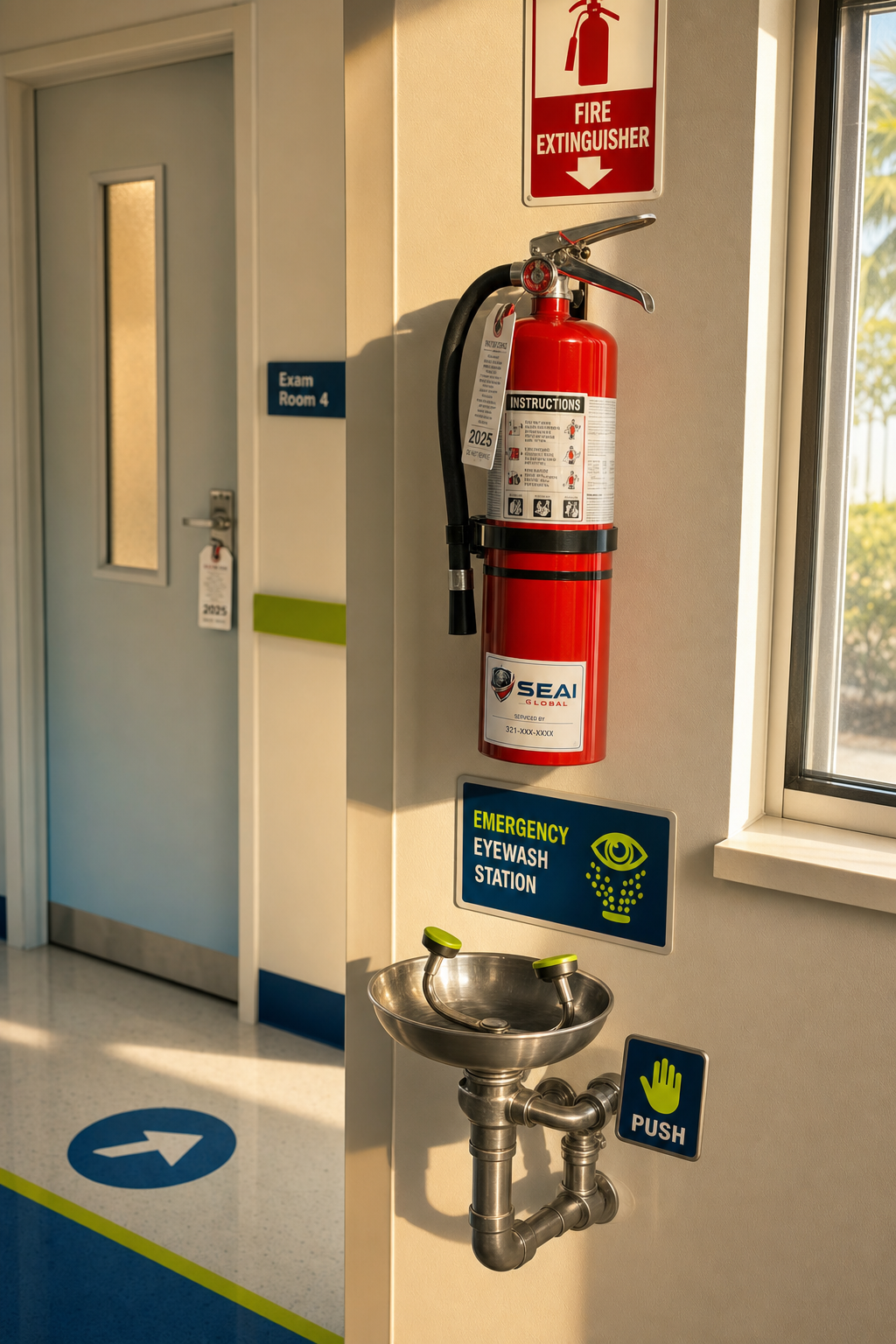
For medical providers in Brevard County, the standard emergency action plan Florida workplace requirements are merely the foundation. Healthcare facilities, including hospitals, surgical centers, and long-term care environments, must navigate a complex intersection of OSHA regulations, the CMS Emergency Preparedness Rule, and Joint Commission standards. While a standard EAP focuses on immediate evacuation and life safety, accredited healthcare facilities must develop a much broader Emergency Operations Plan (EOP).
An EOP expands the scope of preparedness into six critical domains: communications, resources and assets, safety and security, staff responsibilities, utilities, and clinical support. Unlike a standard office, a medical facility often cannot simply evacuate; it must maintain protocols for "shelter-in-place" scenarios for patients who are non-ambulatory or require life-sustaining equipment. This level of operational continuity is a core component of comprehensive risk management solutions tailored for the medical field.
A critical differentiator for Florida healthcare facilities is the Hazard Vulnerability Analysis (HVA). The Joint Commission requires an HVA to identify and prioritize potential emergencies based on their probability and impact. In Melbourne and surrounding coastal areas, this analysis must heavily weight the risks of storm surges and extended power outages that could compromise temperature-sensitive medications or medical gases.
Integrating these advanced requirements requires more than just a document. It demands specialized OSHA training and regular OSHA compliance audits that also account for Environment of Care (EC) and Emergency Management (EM) standards. For clinical leaders, ensuring the EOP aligns with local Brevard County emergency management agencies is essential to maintain accreditation and ensure patient safety during a regional crisis.
Employee Training and Plan Review: When and How Often
Compliance with OSHA 1910.38(f) hinges on the frequency and quality of instruction provided to your workforce. Federal standards mandate training at three specific intervals: when the plan is first developed, whenever an employee's designated actions or responsibilities under the plan change, and if the plan itself undergoes revision. Relying on a one-time orientation during onboarding is a common deficiency frequently identified during OSHA compliance audits.
In the local context, SEAI Global LLC recommends conducting comprehensive drills at least annually. For a Melbourne business, the most strategic time for this review is late spring, immediately preceding the start of the Atlantic hurricane season on June 1. This ensures that your emergency action plan Florida workplace protocols are fresh in the minds of staff before peak storm activity. Training must cover technical details; these include the distinct sounds or visual cues of employee alarm systems, the location of primary and secondary evacuation routes, and specific reporting procedures for fires or other hazards.
Beyond the basics, OSHA training should designate specific roles for those tasked with accounting for personnel at assembly points. Effective comprehensive risk management solutions require a post-drill evaluation to identify bottlenecks in egress or failures in communication. If a drill reveals that staff are confused by exit signage or unsure of their rally point, the plan must be updated and the changes communicated to the entire team immediately to ensure operational readiness.
Common Mistakes in Florida Workplace Emergency Planning
Even with a documented emergency action plan Florida workplace safety often fails due to three common oversights. First, many employers rely on generic, downloaded templates that lack localized details. A template will not account for the specific flooding risks of the Indian River Lagoon or the unique egress challenges of a multi-story medical office in Melbourne. Proper OSHA compliance audits frequently reveal that these plans also neglect employees with disabilities. A compliant plan must include specific procedures for those with mobility, visual, or hearing impairments, such as designated evacuation buddies or specialized notification devices.
Another frequent error involves communication redundancy. Relying solely on internet-based apps or cellular service is risky during Florida storms when power grids and towers fail. Comprehensive risk management solutions require a secondary method, such as two-way radios or a manual call tree, to ensure every person is accounted for. Ultimately, the most dangerous mistake is treating the plan as a static document. A plan that sits on a shelf without being tested through regular drills is effectively useless when a real crisis occurs.
Ensuring your Florida workplace is prepared for emergencies is about more than just checking a box for OSHA compliance. It is about protecting your most valuable assets and ensuring your business can recover quickly from local disasters. If you want expert help developing a robust plan or staying ahead of regulatory changes, our specialized Safety Training offers a practical path forward. We can help you build a safer environment, allowing you to focus on your core operations with peace of mind.