
Florida small businesses must update their hazard communication programs, workplace labeling, and employee training by November 20, 2026, to ensure OSHA Hazard Communication Standard 2026 Florida small business compliance. Manufacturers and distributors have an earlier deadline of May 19, 2026, to adopt revised hazard classifications and safety data sheet requirements. These extended dates provide essential time for employers to align with modernized federal safety protocols and training standards.
Small business owners in Florida are already navigating high operational costs and labor shortages; however, the looming 2026 OSHA Hazard Communication Standard updates present a new regulatory challenge that cannot be ignored. While the compliance deadline may seem distant, the transition to revised labeling and updated Safety Data Sheets requires a meticulous, long term strategy to avoid costly last minute disruptions or non compliance penalties. For Florida enterprises, staying ahead of these federal mandates is essential for both legal security and operational continuity. This guide provides a comprehensive breakdown of the 2026 HazCom extensions, specifically focusing on the updated pictogram requirements and SDS protocols. We will provide a practical roadmap for conducting chemical inventory audits and implementing the mandatory training sessions necessary to ensure your workforce is fully prepared before the November deadline.
Understanding the 2026 OSHA HazCom Extension for Florida Employers

Recent updates from federal OSHA have provided a necessary reprieve for business owners navigating the complexities of the Hazard Communication Standard (HCS) alignment with GHS Revision 7. Initially, many organizations were bracing for a January 2026 deadline; however, OSHA has officially granted a four-month extension, pushing the final implementation dates further into the year. This shift allows more time for the heavy lifting required to update documentation and safety protocols.
For those at the start of the chemical lifecycle, including manufacturers, importers, and distributors, the new compliance date for substances is May 19, 2026. This window is vital for the reclassification of chemicals and the authoring of new Safety Data Sheets (SDS) that reflect the updated GHS criteria. For the majority of our clients in Melbourne and across the state, the most critical date to track is November 20, 2026.
By this November deadline, small businesses must satisfy three core requirements: - Update the written Hazard Communication Program to reflect new classification procedures. - Replace or update workplace container labels to meet the 2026 standards. - Complete and document employee training regarding new hazard pictograms and SDS formats.
While this extension offers breathing room, achieving OSHA Hazard Communication Standard 2026 Florida small business compliance is not a weekend project. GHS Revision 7 introduces nuanced changes to how aerosols, flammable gases, and desensitized explosives are categorized. Starting your transition now ensures that your comprehensive risk management solutions are robust enough to withstand an inspection. Waiting until the final months of 2026 could leave your facility vulnerable to supply chain delays for compliant labeling materials or a backlog in professional training availability.
Key Changes in the 2026 Hazard Communication Standard Update
The transition to GHS Revision 7 introduces specific technical updates that move beyond the 2012 version most Florida employers currently use. To maintain OSHA Hazard Communication Standard 2026 Florida small business compliance, facilities must account for five primary shifts in the regulatory landscape. These changes are not merely administrative; they alter how hazards are identified and communicated on the shop floor.
One of the most significant changes involves hazard classifications. OSHA now requires manufacturers and employers to consider not just the intended use of a chemical, but also any reasonably anticipated uses. This means evaluating potential downstream reactions or byproducts that could occur during normal processing. Additionally, the standard introduces new categories for aerosols, desensitized explosives, and flammable gases. Flammable gases are now subdivided into Category 1A and 1B, which provides more granular data for your comprehensive risk management solutions.
Feature | Previous HCS (2012) | Updated HCS (2026) |
|---|---|---|
Hazard Evaluation | Focused on intended use only | Includes "reasonably anticipated" uses |
Aerosol Category | Flammable aerosols only | Expanded to include non-flammable aerosols |
Small Container Labels | Required full labeling regardless of size | Flexible labeling for containers under 100ml |
Trade Secrets | Limited flexibility on exact percentages | Permits use of prescribed concentration ranges |
SDS Formatting | General hazard identification | Specific requirements for mixture properties |
Labeling for small containers under 100ml has also been updated to provide practical relief. Previously, fitting all required information on a tiny vial was a significant compliance hurdle. The 2026 update allows for abbreviated labeling on the immediate container, provided the outer packaging contains the full suite of GHS information. This is particularly relevant for medical labs and aerospace manufacturing sites in Melbourne that handle specialized reagents.
Trade secret flexibility now allows employers to use concentration ranges for ingredients instead of disclosing exact percentages, protecting proprietary formulas while maintaining safety. Finally, SDS formatting requirements have changed, particularly in Section 2 and Section 3, requiring updated language regarding mixtures. Because these updates are technical, performing OSHA compliance audits is the most effective way to identify which of your current chemicals require new documentation and safety training for your workforce.
The November 2026 Deadline: What Florida Small Businesses Must Do
The November 20, 2026, deadline marks the point where the primary responsibility shifts from the chemical producer to the end user. For a business owner in Florida, this is the date when federal inspectors will expect full alignment with GHS Revision 7 within the four walls of your facility. Meeting OSHA Hazard Communication Standard 2026 Florida small business compliance involves three distinct pillars: documentation, physical labeling, and personnel education.
First, your written Hazard Communication Program must be revised. This is not a simple date change on a cover sheet. The program must now outline how your facility handles the new hazard classifications, such as the nuances between Category 1A and 1B flammable gases or the specific handling of non-flammable aerosols. It should detail your process for SDS management and how you verify that incoming shipments meet the updated standards. For Melbourne businesses in aerospace or marine construction, where specialized resins and solvents are common, the program must also address how these materials are handled during non-routine tasks.
Second, every workplace container must be reviewed. While manufacturers provide the initial labels, any secondary containers, such as spray bottles or transfer tanks, must be updated with the new 2026 requirements. In sectors like healthcare or laboratory services, chemical inventories can be vast and technically complex. Professional OSHA compliance audits are often necessary to ensure no small container or bulk storage tank is overlooked during the transition.
Third, you must provide and document safety training for your workforce. This training must specifically address the new SDS formats and any revised pictograms relevant to your site. OSHA requires that employees understand the specific hazards they encounter during their normal duties and any reasonably anticipated scenarios. Utilizing comprehensive risk management solutions helps ensure these three pillars are integrated into your daily operations well before the deadline arrives, preventing the last minute rush that often leads to documentation errors.
Revised Labeling and Safety Data Sheet SDS Requirements
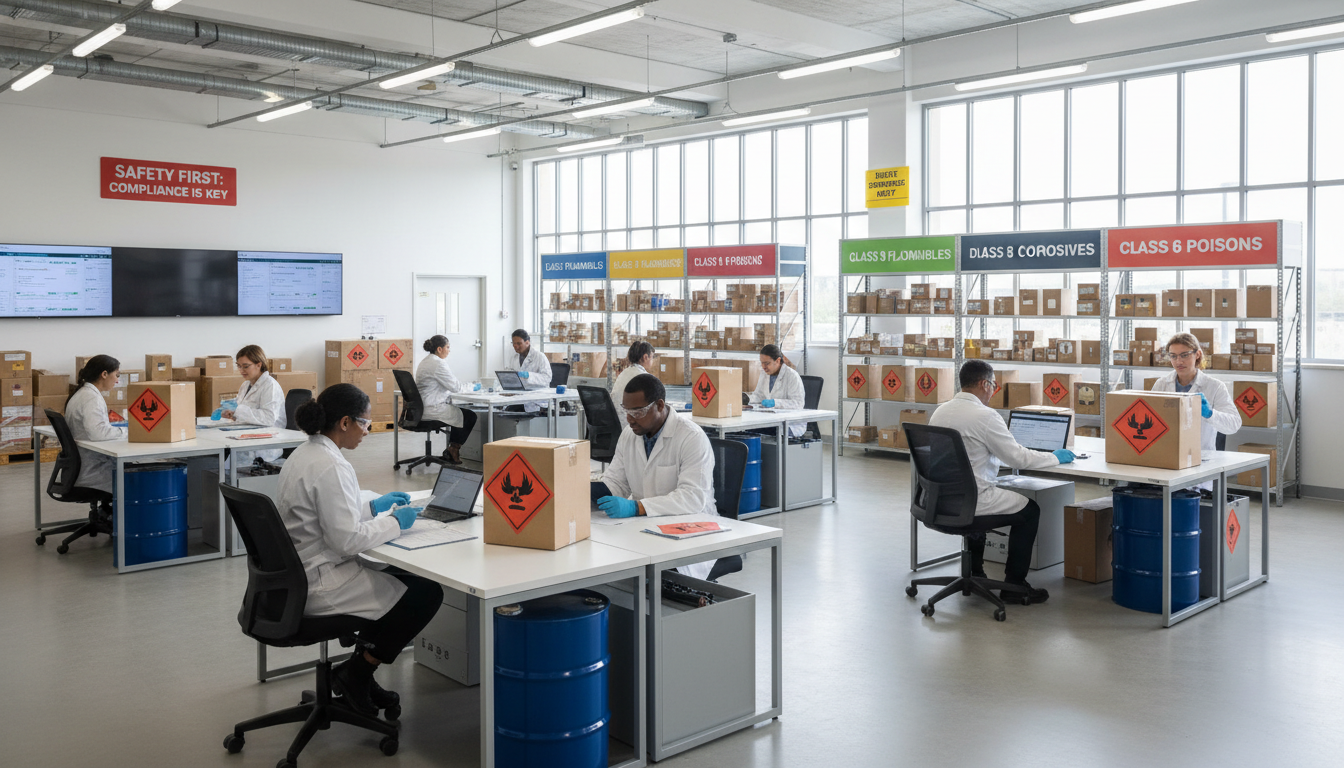
The integration of GHS Revision 7 brings a fundamental shift in how labels and SDSs are structured. While these changes aim to improve clarity, they also place a higher burden of verification on the employer. One of the most significant labeling updates involves small containers under 100ml. For medical facilities and testing labs in Melbourne, labeling tiny vials has historically been a logistical hurdle. The updated standard now allows for abbreviated labeling on the immediate container, provided the outer packaging includes the full set of GHS elements. This flexibility ensures safety without compromising the legibility of information on small-scale equipment.
Safety Data Sheets are also undergoing a technical transformation, particularly regarding Section 2 (Hazard Identification) and Section 3 (Composition/Information on Ingredients). OSHA now mandates that SDSs account for hazardous reactions that occur during the reasonably anticipated use of a chemical. This means an SDS must address not only the chemical in its stable state but also any harmful byproducts created during processing or mixing. For businesses involved in manufacturing, aerospace, or specialized cleaning, this requires a deeper understanding of chemical interactions on the shop floor.
Simply maintaining an inherited SDS folder is no longer a path to OSHA Hazard Communication Standard 2026 Florida small business compliance. A meaningful audit of your entire library, whether digital or physical, is essential to confirm that manufacturers have updated their documents to the 2026 requirements. Ensuring every sheet aligns with the new classification of mixtures is a core component of comprehensive risk management solutions. Utilizing professional OSHA compliance audits can help identify gaps in your documentation, while safety training for your workforce ensures your team can interpret these more complex safety sheets correctly.
How to Conduct a Chemical Inventory Audit for 2026 Compliance
Transitioning from understanding the new SDS requirements to implementing them requires a systematic, hands-on approach. Achieving OSHA Hazard Communication Standard 2026 Florida small business compliance begins with a rigorous chemical inventory audit. This process serves as the foundation for your entire safety program, ensuring that no hazardous material is overlooked during the transition to GHS Revision 7.
Execute a Physical Floor Walk: Document every chemical present in your facility. This includes chemicals in production areas, maintenance closets, and remote storage lockers. For Melbourne-based marine construction or aerospace firms, pay close attention to lubricants, resins, and specialized cleaning solvents that may have been in stock for extended periods.
Audit the SDS Library: Compare your physical list against your current Safety Data Sheet library. If you have a chemical on the shelf without a corresponding SDS, or if the version you have does not account for new aerosol or flammable gas classifications, you have a compliance gap that must be addressed.
Solicit GHS Revision 7 Documentation: Contact manufacturers and distributors to request updated SDSs. While manufacturers have until May 2026 to update their documents, proactive outreach ensures you are not scrambling as the November deadline approaches.
Formalize the Written HazCom Plan: Integrate your updated inventory and new SDSs into your written program. This document must now reflect how your site manages specific labeling for small containers and how you communicate the updated hazard categories.
Managing a wall-to-wall audit internally can be a significant drain on operational resources and often leads to overlooked hazards. SEAI Global specializes in OSHA compliance audits that streamline this entire process. Our experts provide the technical oversight needed to identify chemical byproducts and ensure your comprehensive risk management solutions are robust enough to pass a federal inspection. By partnering with us, you can focus on your core business while we ensure your documentation is accurate and ready for the 2026 shift.
Mandatory Training: Preparing Your Florida Workforce for New Pictograms

A rigorous chemical inventory is only effective if the people handling those substances understand the risks. Under the updated GHS Revision 7 guidelines, meeting OSHA hazard communication standard training requirements involves more than just a generic safety video in the breakroom. OSHA expects training to be meaningful and site specific. This means your employees must be able to recognize how new subcategories, such as the distinction between Category 1A and 1B flammable gases or the expanded classifications for aerosols, apply directly to their daily tasks.
For a technician at a Melbourne aerospace facility or a maintenance worker in a Florida medical center, the pictograms on a container are the first line of defense. If the training does not address the specific chemicals present in their workspace, it fails the compliance test. Employees need to understand that even if a pictogram looks familiar, the underlying criteria for aerosols and desensitized explosives have changed.
SEAI Global provides tailored safety training for your workforce that bridges the gap between regulatory language and shop floor reality. We utilize your actual chemical inventory to ensure that every team member can navigate the updated SDS formats and labeling nuances. Integrating this education into your comprehensive risk management solutions ensures that your facility achieves OSHA Hazard Communication Standard 2026 Florida small business compliance long before the November deadline. Proactive training not only prevents costly citations but also builds a culture of technical competence and safety.
Staying ahead of the 2026 Hazard Communication Standard updates is essential for every Florida small business. By focusing on updated labels, revised safety data sheets, and timely staff training, you protect both your team and your legal standing. Navigating these evolving regulations can be demanding while you manage daily operations. If you want expert help ensuring your facility meets every requirement, our team provides comprehensive support for OSHA Compliance; we simplify the process so you can focus on growth. Proactive planning today prevents costly complications tomorrow.